Returning to the water
Then, at 38, Universidad Católica invited me to join Masters swimming.
The truth is, I did not know much about it at the time. I returned without major competitive expectations. My children and my work were my priorities, and swimming appeared more as a hobby — something that made me feel good and reconnected me with something I had always loved.
I never imagined how far that return would take me.
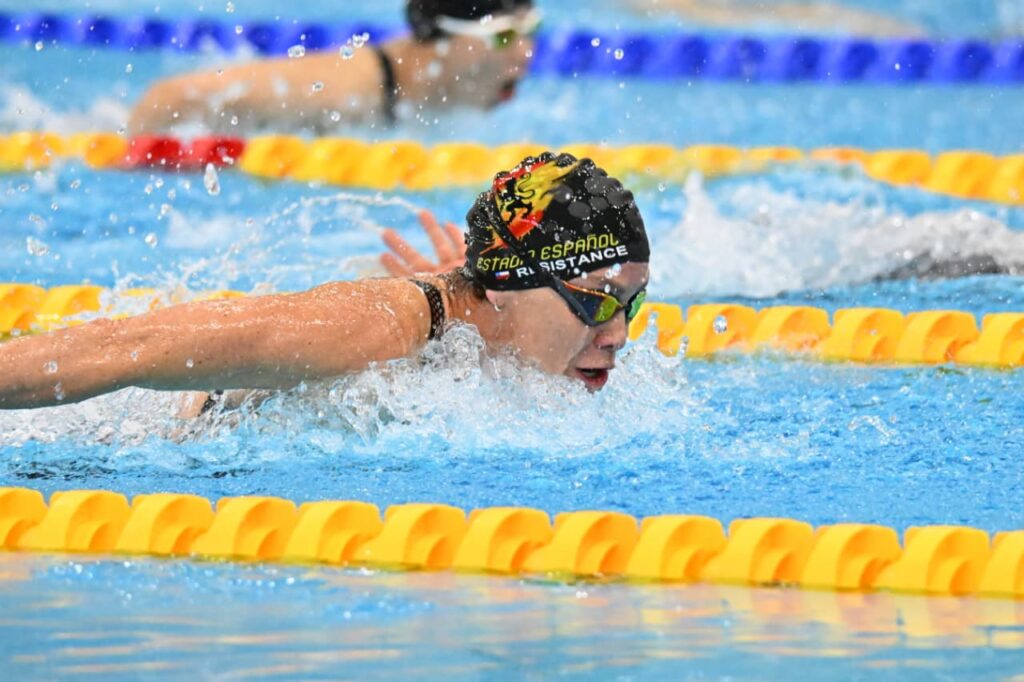
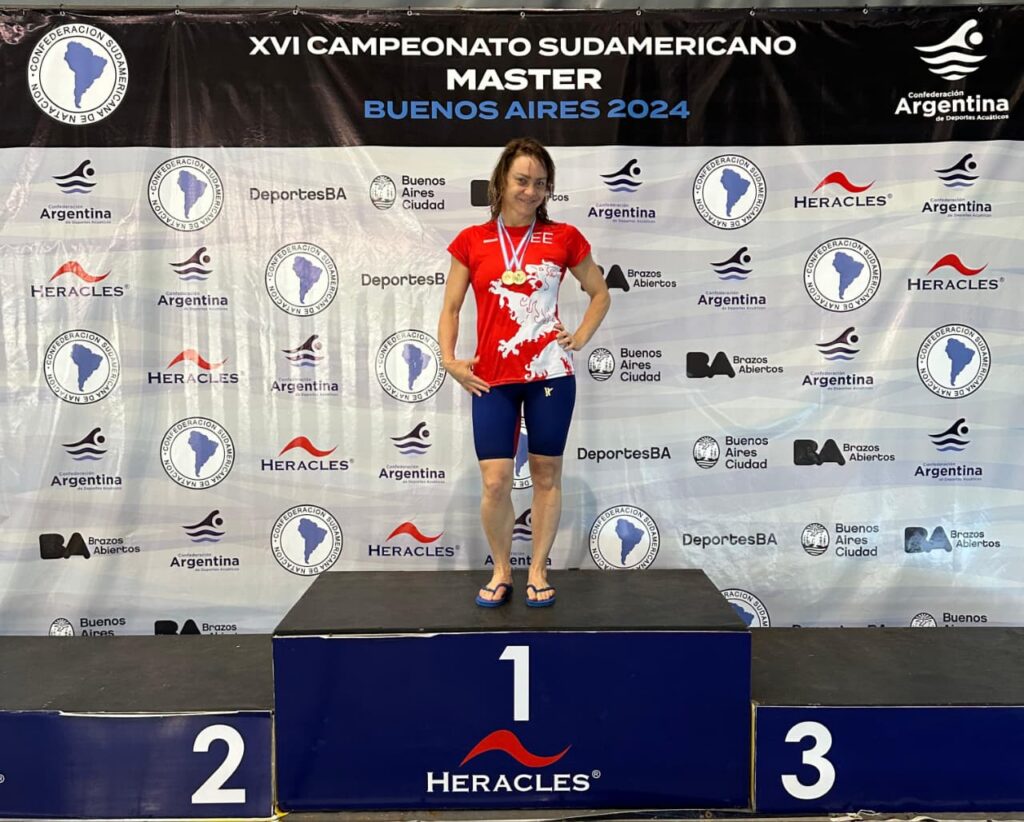
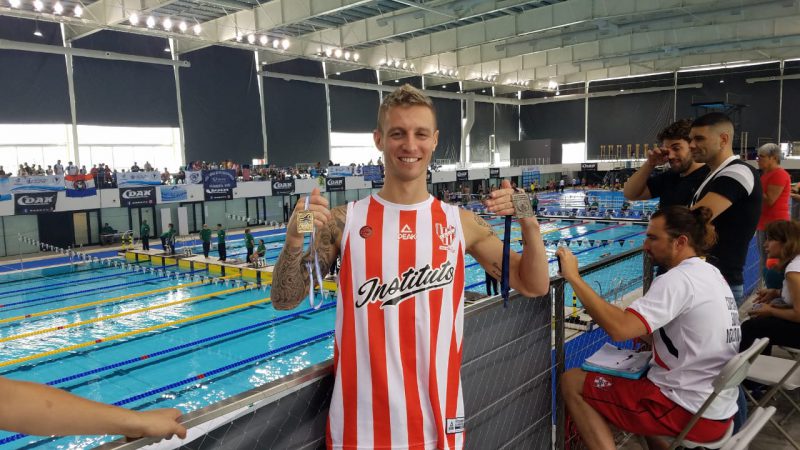
Little by little, I started competing again. There were tournaments, trips, international championships, medals and records.
But perhaps one of the things that surprised me most was discovering that, even as I got older, I could still improve.
I also used to think that with age you could only get slower and, at best, maintain your level.
Until I started beating some of my own times from my younger years.
That completely changed the way I saw things.
Discovering that I could still improve
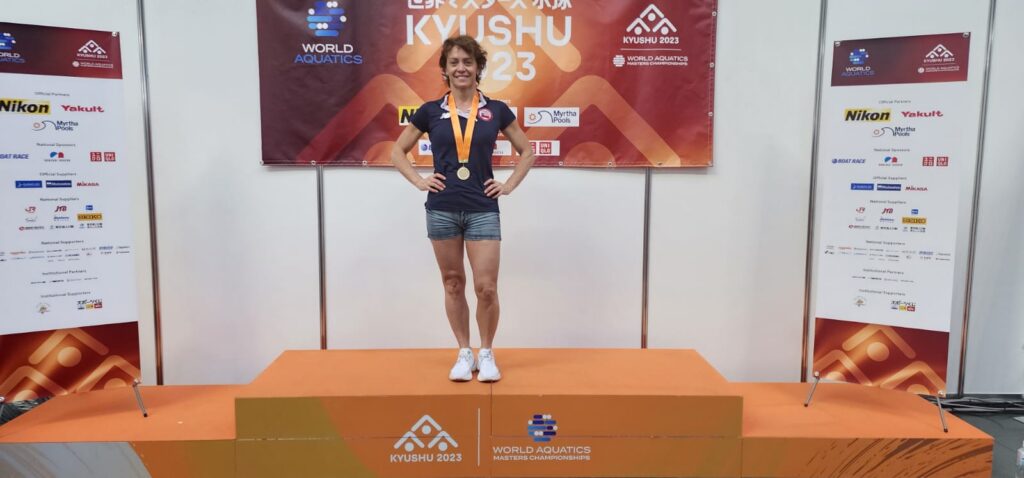
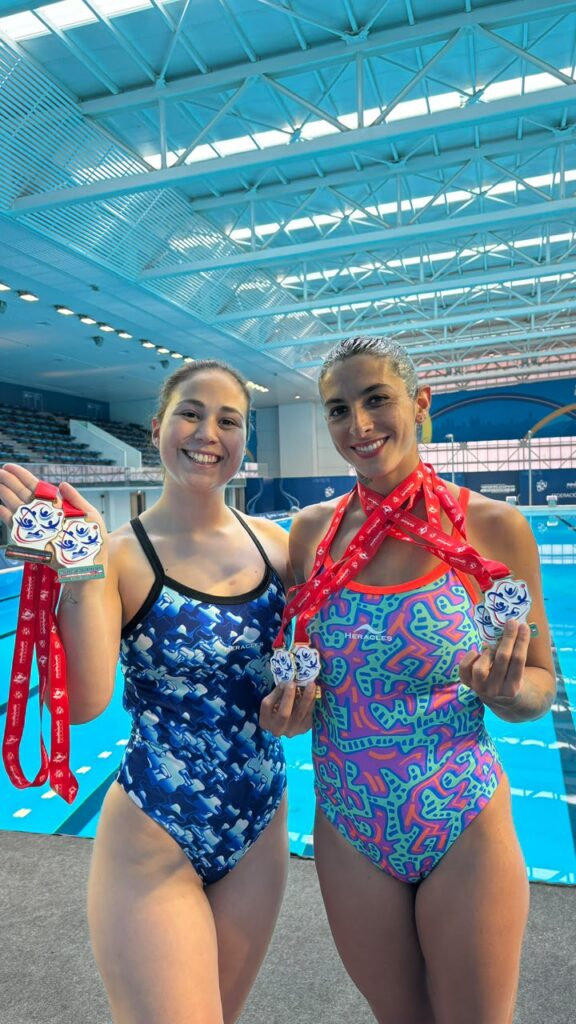
At 55, I achieved my first Masters world record in the 100m butterfly. The following year, at the 2023 World Masters Championships in Japan, I won four gold medals, one silver medal and set three world records.
Even now, thinking about it still makes me emotional. It was one of those moments when I felt on top of the world.
But over the years, I have understood that the most important part of this journey has not only been the records or medals.
It has been everything I have learned along the way.
Resilience, for example.
It is a word we hear all the time, but for me it has taken on a different meaning.
Resilience does not always mean continuing to push at any cost. Sometimes it also means knowing when to stop, rest, accept an injury, ask for help, review the process and return in a different way.
I have also learned something I often repeat:
Perfect conditions don’t exist.
There will always be something — tiredness, fear, pain, a bad night’s sleep, personal problems, limited training, or that conversation you have with yourself before getting into the water, looking for an excuse in case things do not go well.
Over time, I learned to give all of those things their place and then simply get into the water and give the best I can that day.
And if it does not go as I hoped, that is okay.
There will always be another chance.
What challenges can teach us
Failures are also part of the process.
They keep your feet on the ground. They make you learn, reassess, reinvent yourself and continue.
I also came to understand that resting does not mean giving up, and that many times it is discipline that keeps you going when motivation is not there.
There is something else this journey has taught me: no achievement is completely individual.
When I think about my best moments, I imagine a huge pyramid of people supporting me and pushing me upward — my family, my children, my coaches, swimmer friends, doctors, teammates, friends and my community.
So many people, in one way or another, have been part of this story.
My coaches have played a fundamental role, not only in developing my athletic abilities but also in shaping my character. Through them, I have learned about trust, respect, discipline, perseverance and teamwork.
The value of Masters swimming
That is why Masters swimming has such enormous value for me.
It allows you to continue setting goals, learning, sharing with people who have the same passion and discovering that there are still many things left to do.
Today, I am close to turning 60, and of course my body is not the same as it was at 20.
I have had injuries. I have had to reduce training loads, strengthen, rehabilitate and learn to listen much more carefully to my body.
Age is real. It would be absurd to say otherwise.
But I believe we can do a great deal when it comes to how we age.
For me, that is what active longevity means: not trying to be 20 again, but reaching your 40s, 50s, 60s, 70s and beyond with projects, movement, relationships, curiosity and a desire to continue enjoying life.
And swimming can be a wonderful companion in that journey.
It is much more than a sport.
Swimming makes every cell in my body feel alive. It takes me to another dimension. It is my escape.
When I put my head underwater, the noise disappears. My mind wanders, I dream, I feel free. I enjoy every stroke, every movement and the feeling of the water embracing me.
There are days when I have absolutely no desire to train and I go almost reluctantly, but I cannot remember a single day when I regretted going once I was finished.
That feeling of happiness afterward is priceless.
The pool is still there
That is why, when someone tells me, “I used to swim,” I often think:
Why only in the past?
The pool is still there.
You do not have to return as the swimmer you once were.
You can return as the person you are today, with a different body, a different speed, different responsibilities and a different story.
And if you have never swum before, it is not too late to start.
Not everyone needs to compete, win medals or break records.
For someone, the challenge may be swimming their first length, learning a stroke, feeling comfortable in the water again, sharing time with others or simply giving themselves a couple of hours each week.
When I returned to Masters swimming, I only wanted to swim.
I ended up going much further than I ever imagined.
Perhaps that is why, if there is one thing I would like people to take from my story, it is this:
Do not let age decide before we do how far we are still capable of going.
And for as long as I can, I will keep getting into the water.