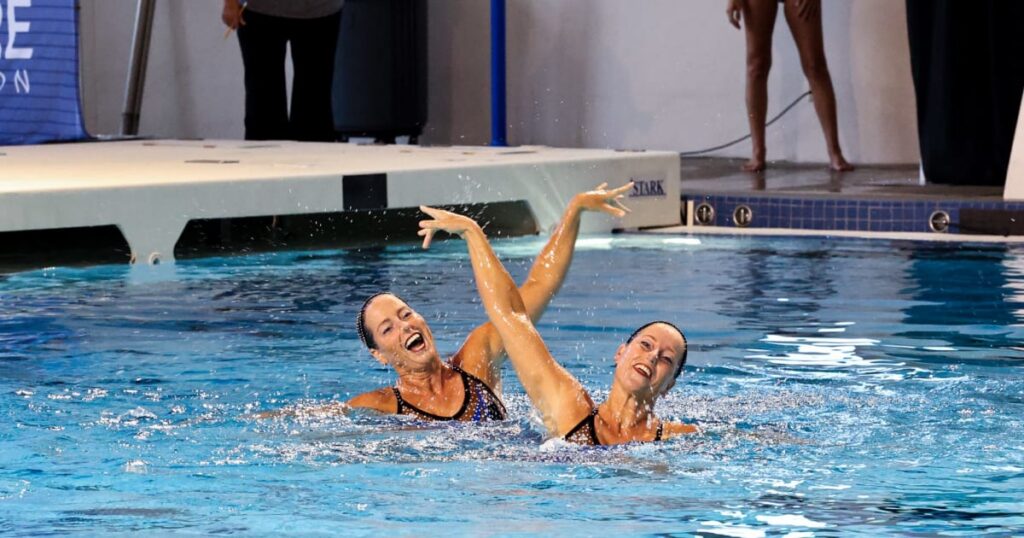

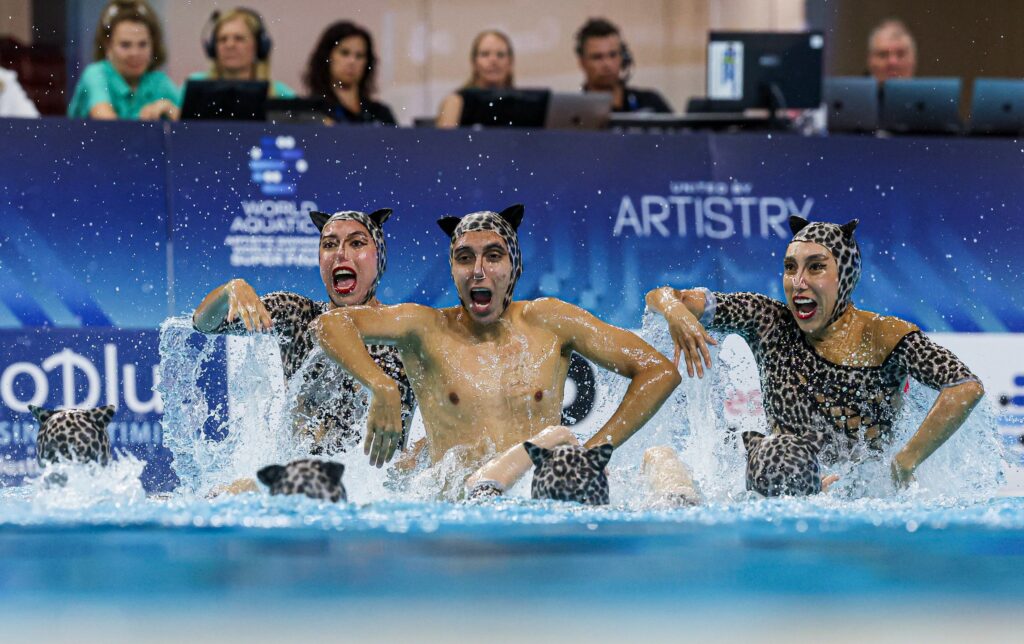
Artistic swimming can appear effortless from the stands: athletes moving together, interpreting music, and creating formations while seemingly floating across the water.
Behind that performance, however, is one of the most detailed judging systems in international sports history.
Under the current World Aquatics system, routines are evaluated through two primary scoring areas: Elements and Artistic Impression. The final result also includes synchronization deductions and any additional penalties that may apply.
The Elements score reflects both the difficulty of the content and the quality with which it is performed.
Before the competition, the coach submits a Coach Card listing the routine’s planned technical elements, hybrids, acrobatic movements, and declared degrees of difficulty.
The execution judges then evaluate how well those elements are performed. They consider qualities such as height, control, accuracy, extension, stability, and overall mastery.
The Artistic Impression judges evaluate the routine as a complete performance. They consider the choreography, musicality, creativity, presentation, use of the pool, and the way the athletes connect the routine’s different movements and elements.
Alongside the judging panels, two groups of technical controllers play an important role in determining the final result.
The Difficulty Technical Controllers, or DTCs, follow the routine in real time and compare what is performed in the water with what was declared on the Coach Card. They verify the number, order, and completion of the declared difficulty in each routine, including whether required technical elements are performed as declared and whether any part is omitted or does not meet the established requirements.
When the performance does not match the Coach Card, or an element does not meet the necessary standard, the degree of difficulty credited to the routine may be affected.
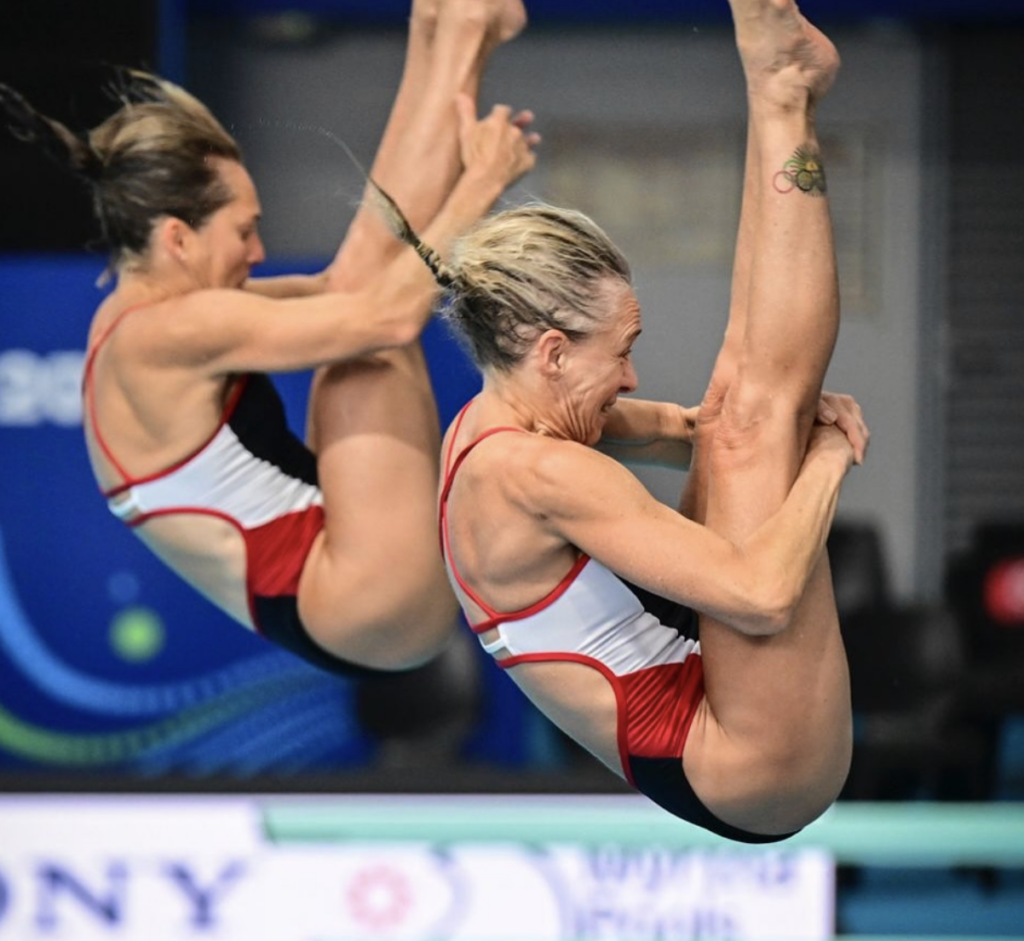
The Synchronization Technical Controllers, or STCs, observe and record synchronization errors throughout the routine. These are moments when athletes perform unequal actions or are not moving together as intended. The synchronization errors recorded by the STCs are then used to calculate deductions from the routine elements score.
This creates a system in which the judges evaluate the quality and artistry of the performance, while the technical controllers confirm the declared content and record synchronization errors.
A routine may carry an ambitious degree of difficulty, but that value must still be demonstrated accurately in the water, and the athletes must perform together.
A Sport That Has Always Evolved
Artistic swimming has always been an evolving sport.
Every year, athletes and coaches introduce new movements, combinations, and ways of interpreting music in the water. As the rules develop, the sport continues to demand new levels of creativity, athleticism, and technical understanding.
That evolution is part of what makes artistic swimming so exciting. It can also make the sport feel complicated, especially under the current scoring system.
Difficulty is declared before the routine begins. Hybrids are constructed using recognized movements, rotations, positions, and connections. Acrobatic movements have assigned degrees of difficulty. Technical routines contain required elements that must be completed according to precise standards.
For athletes, this means that performing a routine that simply looks difficult is no longer enough. What is planned, what is declared, and what is performed must match.
For spectators, the results can sometimes be surprising.
A routine may look exciting, powerful, and nearly flawless, but receive a lower score than expected because an element was not fully credited or because synchronization errors affected the result. Another routine may appear more controlled or less dramatic but score higher because its declared content was completed more successfully.
That is one of the most important things to understand about artistic swimming’s new era: difficulty creates opportunity, but execution determines how much of that opportunity becomes part of the final score.
Experiencing Both Systems
I feel uniquely connected to this moment in the sport because I competed under both the previous scoring system and the first version of the new system.
I entered artistic swimming after years as a competitive swimmer. At that time, the sport had a deeply established method of judging routines. We understood that execution, synchronization, and artistic impression were essential. Difficulty mattered, but it was considered more broadly within the complete performance.
When the new system was introduced, the way we approached competition changed.
Suddenly, athletes and coaches were not only creating routines. We were calculating them.
Every hybrid, rotation, connection, acrobatic movement, and technical element had to be considered strategically. We had to understand how a routine would be evaluated not only as a performance, but also as a detailed technical plan.
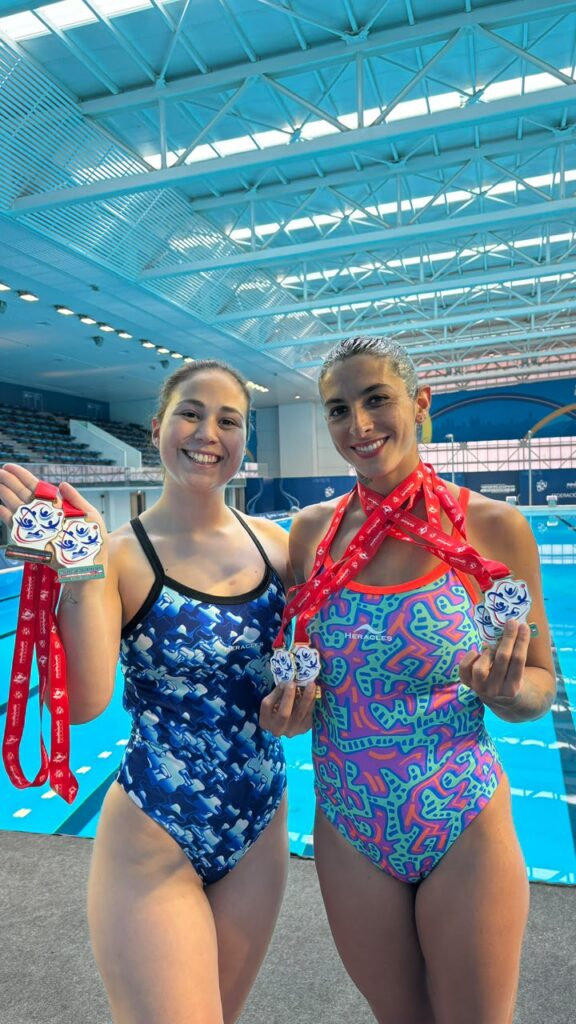
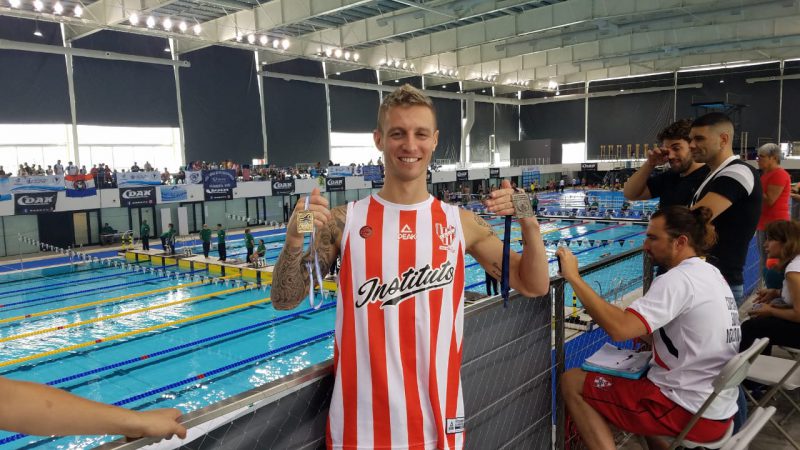
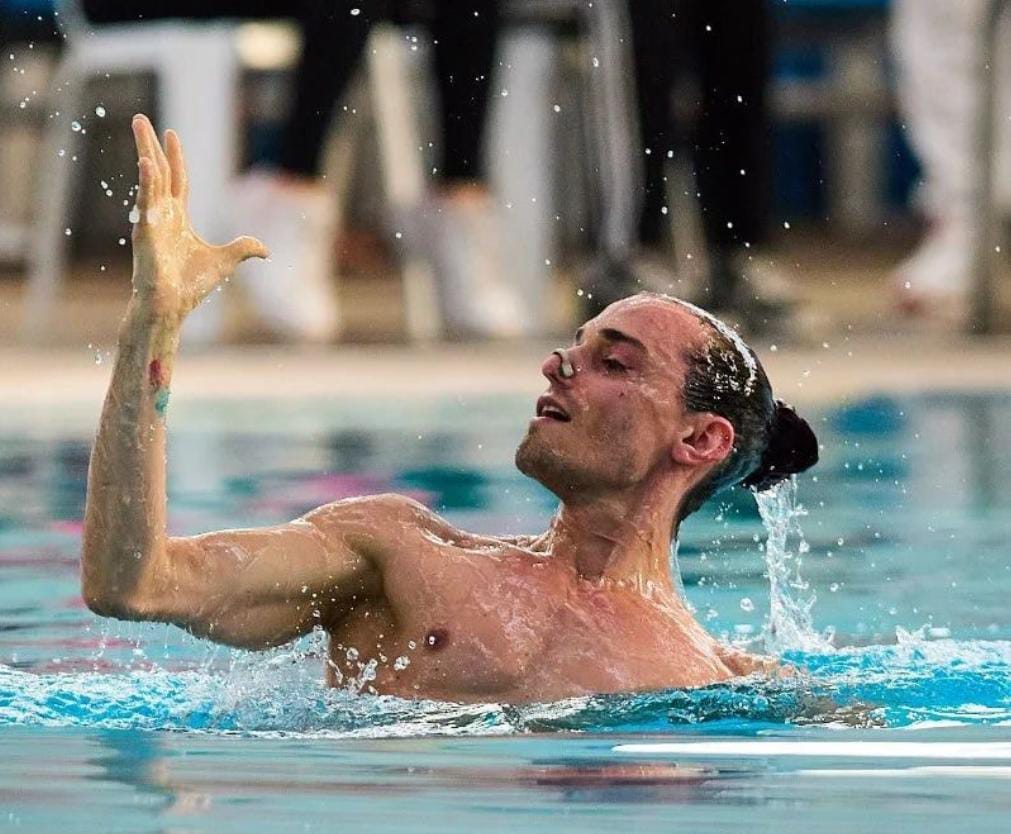
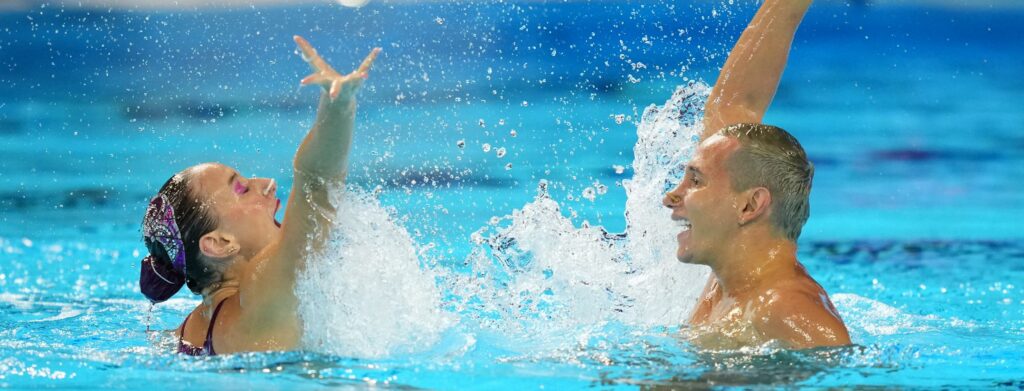
I competed under the updated system in 2023, including at the Central American and Caribbean Games in El Salvador, where my mixed duet partner, Nicolle Torrens, and I earned a bronze medal for Puerto Rico.
Competing during that transitional period gave me a direct understanding of how overwhelming the change could feel. Athletes were learning new terminology, coaches were reconstructing routines, and officials were working to apply an entirely new method of evaluation.
Everyone was adjusting at the same time.
In 2026, routines have become faster. Transitions are sharper and more complex. Hybrids contain greater density and detail. Athletes spend extended periods underwater, and choreography often moves directly from one demanding element to another with very little opportunity to recover.
The physical and mental expectations placed on artistic swimmers are extraordinary.
What the New System Is Trying to Accomplish
At its core, the current system is designed to make difficulty more measurable and judgment more transparent.
Artistic swimming will always involve human interpretation. Musicality, choreography, performance, and emotion cannot be reduced entirely to numbers. However, the system creates a clearer structure for identifying what athletes intend to perform and determining whether they successfully complete it.
The Coach Card establishes the routine’s planned elements and difficulty, creating the technical plan against which the performance is evaluated.
This has created an important strategic question:
Is it better to declare the most difficult routine possible, or to declare the most difficult routine that can be performed successfully and consistently?
A high-risk routine can produce an extraordinary score when everything is completed. But when athletes are tired, nervous, or slightly out of position, one mistake can affect more than a single moment. It can change the value credited to an entire hybrid or element.
Routine construction has therefore become a critical part of competitive strategy. A successful program must consider not only what athletes are capable of completing in training, but what they can reproduce under pressure, after travel, in an unfamiliar pool, and on the biggest day of their season.
Difficulty Is Only One Part of the Performance
One concern surrounding the current system is whether the emphasis on declared difficulty could cause artistic swimming to lose some of its artistry.
It is a valid concern, but it is not one I ultimately agree with.
When routines become faster and more technically dense, there can be less time for extended choreography, creative formations, and moments that allow the audience to connect emotionally with the performance. At times, routines may appear to move constantly from one high-value element to the next.
However, I do not believe artistry is disappearing. I believe athletes and coaches are being challenged to find artistry within a more demanding technical structure.
As an athlete from a small island, I also see something deeply positive in this system: it gives every country a fairer opportunity to compete. When difficulty is declared, and athletes are rewarded for what they successfully perform, a program’s reputation or history does not have to determine its future.
Countries with fewer resources and smaller athlete pools can still build smart routines, execute them well, and place themselves in medal contention.
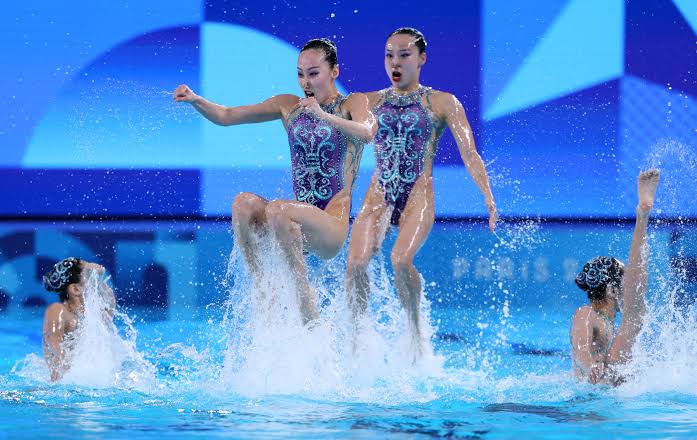
We have seen that shift in recent major competitions, including the Paris 2024 Olympic Games. The podium is no longer reserved for exactly the same countries year after year. New nations and programs are breaking through, established powers are being challenged, and the results feel less predictable.
That has been a breath of fresh air for the sport. More importantly, it has given athletes from every country a reason to keep dreaming and pushing. They can look at the results and believe that a high placement is possible for them too—not someday in theory, but now, if they prepare, perform, and deliver when it matters.
To me, that does not take artistry away from artistic swimming. It gives more athletes the opportunity to bring their own artistry, culture, music, and identity to the highest levels of the sport.
The strongest routines do not simply complete difficult elements. They create performances in which the difficulty feels connected to the music, choreography, and overall concept.
The movements do not appear to have been inserted only to earn points. They belong within the routine.
The moments between the major elements must also have intention. They must move the athletes through the pool, develop the music, change formations, and prepare the audience for what comes next.
A routine with impressive difficulty can lose its impact if the athletes appear rushed, disconnected from the music, or unable to maintain synchronization. In the same way, a beautiful routine still needs enough technical content to remain competitive.
The best programs understand that difficulty, execution, and artistry are not separate goals. Each one must support the others.
What Spectators Should Watch For
For those watching artistic swimming at the Central American Games, there is more happening than what is immediately visible on the surface.
Begin by watching how the routine moves from one section to another. Notice how quickly and cleanly the athletes change formations. Look at whether the choreography connects naturally to the technical elements or whether the routine appears to stop and restart.
Pay attention to the speed and purpose of every movement. Even the strokes and propulsions used to travel across the pool contribute to the overall impression of the routine.
During hybrids, watch the athletes’ legs. Are the positions clearly defined? Are the knees and feet extended? Are the rotations controlled? Are the athletes maintaining similar height? Are they completing the movements?
During acrobatics, observe the height, control, and landing. A movement may be spectacular, but it must also be performed safely and with precision.
Watch the patterns as well. From the side of the pool, a formation may appear correct, while the overhead view can reveal small differences in spacing or alignment.
Athletes must maintain awareness of their own bodies, their teammates, the music, and their location in the pool, often while upside down and unable to see clearly.
Then watch what happens immediately after the most difficult elements.
One of the hardest parts of artistic swimming is continuing to perform while exhausted. Athletes may have spent an extended period underwater completing a hybrid, yet they must surface with confidence, remain connected to the music, and move immediately into the next section without revealing their fatigue.
That illusion of effortlessness is one of the sport’s greatest skills.
It is also important to remember that a routine is not necessarily successful simply because no obvious mistake was visible. Small differences in angles, rotations, height, stability, or timing can affect how an element is evaluated.
The more people understand these details, the more impressive the performances become.
One Routine at a Time
To every athlete preparing for the Central American Games: do not allow the scoring system to become bigger than your performance.
Know your routine. Understand your elements. Trust the work that went into constructing your difficulty.
But when you stand behind the pool and hear your name announced, let the calculations go.
You cannot swim the entire competition at once.
You cannot control another athlete’s declared difficulty, the order of competition, the decisions made by the officials, or the final score. You cannot rewrite the rules in the moments before you compete.
You can control how you enter the water.
You can control your first count, your first breath, and your connection with your teammates. You can commit to every movement, listen to the music, and trust the preparation that brought you to the Games.
The judges will evaluate the elements and the artistic impression. The technical controllers will verify the declared content and record synchronization errors.
But the athlete’s responsibility in that moment is much simpler:
Swim the routine.
Do not carry the weight of the entire competition onto the starting platform. Focus on the movement directly in front of you.
Then focus on the next movement.
Then the next.
Artistic swimming may look different from the sport many of us first entered, but its heart remains the same: athletes entering the water together and creating something powerful, beautiful, and unforgettable.
Trust your training. Trust your teammates. Trust yourself.
One routine at a time.